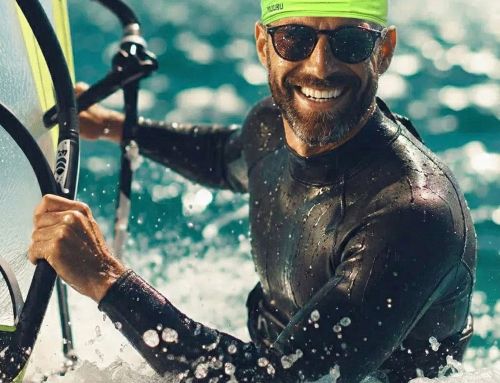
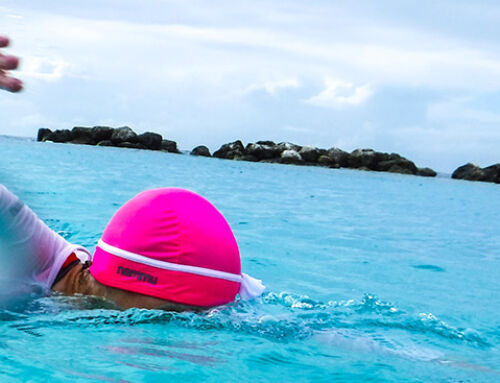
Both UPF clothing and sunscreen protect you from UV radiation. But when it comes to swimming specifically, they perform very differently. Understanding the difference can mean the difference between real protection and a false sense of security.
How Sunscreen Fails in Water
Sunscreen is effective on dry skin. In the water, it faces several challenges:
It washes off. Even water-resistant formulas lose significant protection after 40 to 80 minutes in the water. Most people apply once and stay in the water for much longer.
Application is incomplete. Studies consistently show that people apply about 25-50% of the recommended amount of sunscreen. Thin application dramatically reduces the SPF.
The scalp is almost impossible to cover. Applying sunscreen thoroughly to a full head of hair — or even a shaved head — is impractical. Most people skip it entirely.
It affects marine ecosystems. Chemical sunscreen ingredients including oxybenzone and octinoxate are toxic to coral reefs. They are banned in Hawaii, the US Virgin Islands, and increasingly in other marine protected areas worldwide.
How UPF Clothing Works
UPF (Ultraviolet Protection Factor) clothing blocks UV radiation through the physical barrier of the fabric itself. UPF 50+ fabric blocks 98% of UV rays regardless of how long you have been in the water.
There is no application, no reapplication, no washing off, and no reef impact. The protection is continuous and consistent.
A UPF 50+ swim hat covers the scalp, neck, and ears — areas sunscreen almost never reaches adequately. A UPF swim shirt covers the torso and arms with the same continuous protection.
Head-to-Head Comparison
Effectiveness in water: UPF clothing wins. Protection does not diminish with water exposure or time.
Ease of use: UPF clothing wins. Put it on once. No reapplication.
Scalp coverage: UPF clothing wins. Sunscreen on the scalp is impractical. A swim hat solves it entirely.
Environmental impact: UPF clothing wins. No chemicals, no reef damage.
Face and exposed skin: Sunscreen wins. UPF clothing cannot cover every surface. Mineral sunscreen fills the gaps.
The Best Approach
UPF clothing and sunscreen are not competitors — they are complements. The most effective approach is to use UPF clothing for everything it can cover (torso, arms, scalp, neck, ears) and mineral sunscreen for exposed skin like the face, hands, and legs.
This combination gives you complete coverage, reduces your sunscreen usage significantly, and keeps you protected longer without constant reapplication.
For swimming and snorkeling specifically, start with a UPF 50+ swim hat and a swim shirt. Add mineral sunscreen for any remaining exposed areas. That’s the complete sun protection stack.
Related Posts